






Scientists in Japan have discovered that multiple strains of bacteria taken from frogs, newts, and lizards can be effective against human colon cancer in a mouse model. One particular microbe achieved a perfect response rate and survival [1].
Bacteria against cancer
Recent research has illuminated the enormous impact of the microbiome on overall health. Microbes that live inside us can influence metabolism, modulate inflammation, tune hormone and neurotransmitter signaling, and alter drug breakdown and absorption [2]. Via their immunomodulatory action, bacteria can influence susceptibility not just to infections and autoimmunity but also cancer, affecting its initiation, progression, and responses to therapy [3].
In a new study published in Gut Microbes, the research team of Prof. Eijiro Miyako at the Japan Advanced Institute of Science and Technology (JAIST) ventured one step further from the human microbiome. They gathered and analyzed bacteria from three vertebrate species – two amphibians (Dryophytes japonicus and Cynops pyrrhogaster) and a reptile (Takydromus tachydromoides) – to see if they could find strains that actively suppress cancer.
100% kill rate
After an initial assessment, the team chose nine strains for further evaluation in a mouse colon cancer model. Immunocompetent mice were inoculated with human colon cancer cells subcutaneously, and after the tumors grew to 200 mm3, the study group received a single intravenous injection of a bacterial suspension. Tumor growth was then monitored for 40 days.
One strain produced no antitumor activity, which is still an important result, “indicating that not all gut bacteria possess intrinsic anticancer properties,” the paper says. The rest showed at least some slowing of tumor progression and survival improvement.
One particular bug stood out: Ewingella americana, taken from the guts of Dryophytes japonicus, the Japanese tree frog. Rarely do cancer studies produce such convincing results: E. americana achieved fast and complete tumor eradication in all mice. The entire study group survived until the end of the follow-up, while the entire control group was dead before day 30. When the control group was subjected to tumor rechallenge, none developed cancer, suggesting long-lasting anti-cancer immunity.
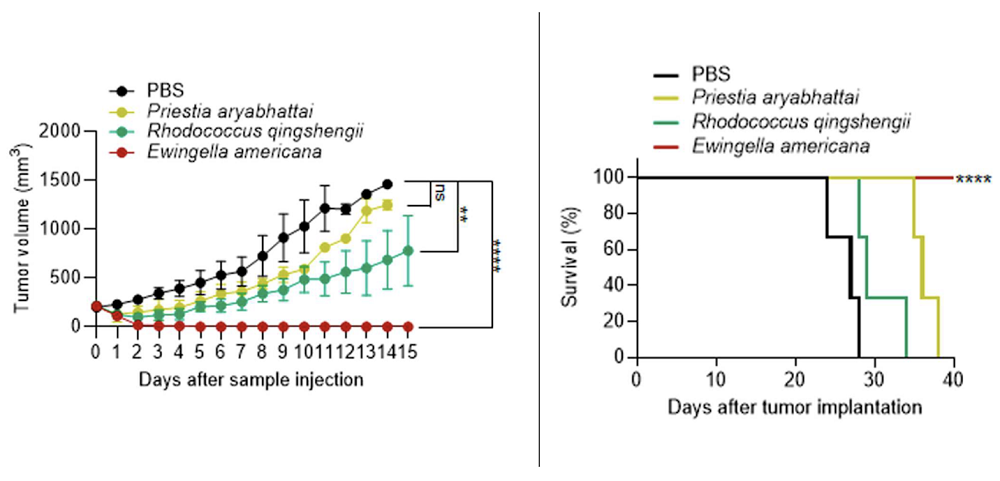
The researchers then compared E. americana’s efficacy to that of two established anti-cancer treatments: PD-1L checkpoint blockade and the chemotherapy drug doxorubicin. While the two treatments showed some efficacy, none of them came close to E. americana’s results.
The therapy was well-tolerated and safe. “Comprehensive analysis of hematological and biochemical parameters revealed no significant differences between E. americana-treated mice and PBS-treated control groups across all measured parameters,” the paper notes. Histology confirmed no detectable organ toxicity or structural damage.
Essentially, after the injection, E. americana colonized the tumor, quickly destroyed it, and then was itself cleared out by the immune system, leaving no trace except for the prolonged immunity. In any case, E. americana is known to respond well to antibiotics, so any lingering infection can probably be easily treated.
Direct cytotoxicity combined with immune recruitment
The authors then delve deeper into possible mechanisms of action. Interestingly, two more bacteria achieved initial tumor regression, but then cancer rebounded. Like E. americana, these two are facultative anaerobic bacteria, meaning that they can thrive in both oxygen-rich and hypoxic environments. The researchers note thhis finding is “consistent with established principles of bacterial cancer therapy, as anaerobic bacteria possess the unique capability to selectively accumulate and colonize within solid tumors due to the characteristically hypoxic and immunosuppressive tumor microenvironment.”
Working with an in vitro tumor model, the team found that E. americana killed lumps of cancer cells (cancer spheroids) directly by secreting cytolysins, toxins that create pores in cellular membranes. However, in vivo, the bacteria also recruited B cells, T cells, and neutrophils. This massive immune cell mobilization and accompanying increase in inflammatory signals, including interferon-gamma (IFN-γ) and tumor necrosis factor-alpha (TNF-α), probably contributed a lot to the treatment’s effectiveness. The researchers confirmed tumor destruction using techniques for detecting cellular death by apoptosis.
“Collectively, these mechanistic investigations demonstrate that E. americana employs a multifaceted approach to achieve tumor elimination, combining direct bacterial-mediated cytotoxicity with robust activation of host immune responses,” the paper concludes. “The bacterium efficiently infiltrates and proliferates within tumors, where it exerts direct cytotoxic effects while simultaneously activating immune cells (particularly T cells, B cells, and neutrophils) to effectively eliminate cancer cells through complementary mechanisms.”
Like any study, this one had certain limitations. For instance, the colon cancer model was subcutaneous instead of gastrointestinal. However, as the authors note, such a model can be especially relevant for metastatic cancers, the deadliest variety. It also remains to be seen whether E. americana is effective against other cancers and how it fares in combination with other bacteria or treatments.
Literature
[1] Iwata, S., Yamasita, N., Asukabe, K., Sakari, M., & Miyako, E. (2025). Discovery and characterization of antitumor gut microbiota from amphibians and reptiles: Ewingella americana as a novel therapeutic agent with dual cytotoxic and immunomodulatory properties. Gut Microbes, 17(1).
[2] Hou, K., Wu, Z.-X., Chen, X.-Y., et al. (2022). Microbiota in health and diseases. Signal Transduction and Targeted Therapy, 7, Article 135
[3] Dutta, D., & Lim, S. H. (2020). Bidirectional interaction between intestinal microbiome and cancer: opportunities for therapeutic interventions. Biomarker Research, 8(1), 31.
View the article at lifespan.io


